
Quick summary
- Consumer-protection police (CPPD), the Thai FDA and the Department of Thai Traditional and Alternative Medicine searched a shop on Banthat Thong Road, Pathum Wan, Bangkok, under a court warrant; results were reported on 1 November 2026.
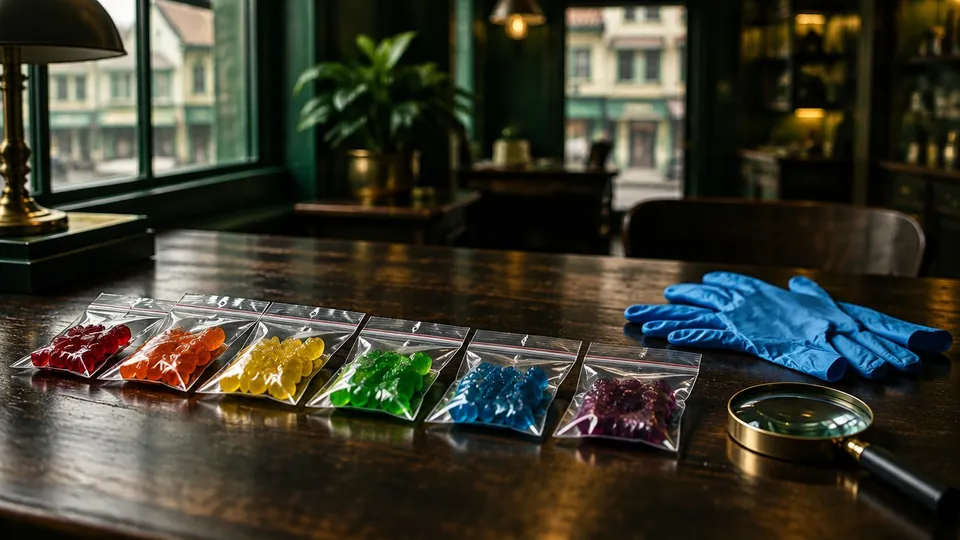
- Officers seized 90 cannabis-infused jellies worth about 50,000 baht, with no Thai label and no FDA food registration number, in packaging resembling children's sweets.
- The search followed the case of a Chanthaburi family hospitalised in mid-October after eating snacks bought online.
- Initial charges: selling a controlled herb without a licence and selling food with incorrect labelling. Samples are being tested for THC/CBD; more charges may follow.
What happened on Banthat Thong Road
Several Thai outlets, including Daily News, Thai PBS, Thairath and PPTV, reported on 1 November 2026 that Sub-division 4 of the Consumer Protection Police Division, together with Thai FDA and Department of Thai Traditional and Alternative Medicine officials, used a Pathum Wan District Court warrant to search a commercial building on Banthat Thong Road in Wang Mai, Pathum Wan. (One outlet dates the search to 29 October 2026.)
The second floor was being used as a cannabis and flower shop. Officers found 90 cannabis jellies in brightly coloured packets that looked like ordinary children's sweets, with no Thai-language label and no food registration number.
A 26-year-old female employee told police she was only staff, selling the jellies at 80 baht each to local customers and foreign tourists, and that the shop had been selling them for about a year, in store and through social-media advertising.
Link to the Chanthaburi family case
According to the reports, the investigation began with the case of a family in Khlung, Chanthaburi, where two parents and their two-year-old son fell seriously ill after eating snacks ordered online. The adults suffered seizures and lost consciousness and needed ventilator support; the child was drowsy. Police say they traced the product back to a shop in the Banthat Thong area.
As of 1 November, reports had not published laboratory results for the snacks the family ate, and no charge directly related to their illness has been announced. That part of the story awaits the official investigation.
Charges and penalties
PPTV reported two initial charges:
- Selling a controlled herb (cannabis) without a licence under the Thai Traditional Medicine Protection and Promotion Act 1999: up to 1 year in prison, a fine of up to 20,000 baht, or both.
- Selling food with incorrect labelling under the Food Act 1979: a fine of up to 30,000 baht.
Samples go to the Department of Medical Sciences for THC and CBD testing. Officials said further charges may be added if levels exceed legal limits. For an overview of penalties, see Cannabis penalties in Thailand.
The rules on cannabis edibles
The Thai FDA secretary-general reminded the public that legally sold cannabis food must be authorised, contain no more than 1.6 mg of THC per package, and carry a clear warning on the label. Separately, under the Ministry of Public Health's controlled-herb rules, cannabis flower may not be sold online and sellers must be licensed. More detail: Cannabis leaves and food: what the law says.
Warning signs on sweets or jellies:
- No Thai label, no ingredient list or no 13-digit food registration number
- Packaging that mimics children's sweets or familiar snack brands but shows a cannabis leaf
- Sold via social media or parcel delivery by an unidentified seller
Advice for parents and visitors
The FDA advises parents not to let children eat any food containing cannabis and to keep sweets of unknown origin out of reach. Anyone who becomes drowsy, has seizures, palpitations or difficulty breathing after eating such products should be taken to hospital immediately, with the packaging.
Visitors should know that cannabis products in Thailand may only be sold by licensed premises. See How to check a licensed cannabis shop and our cannabis guide for tourists.
Police ask the public to report sales of cannabis sweets, especially near schools, to the CPPD hotline 1135.
What comes next
Key next steps are the THC/CBD test results, any action against the shop owner or producer, and the outcome of the Chanthaburi investigation. This page will be updated when official information is released.
This article is general information, not legal advice. This website is not a government agency.
Sources
- เดลินิวส์ – บุกทลาย ‘เยลลี่กัญชา’ เปิดขายเป็นปีย่านบรรทัดทอง
- Thai PBS – ตร.บุกจับร้านเยลลี่กัญชา ย่านบรรทัดทอง ยึด 90 ชิ้น
- PPTV – บุกทลายแหล่งขาย “เยลลี่ผสมกัญชา” ย่านบรรทัดทอง แจ้ง 2 ข้อหา
- ไทยรัฐ – บุกค้นกลางกรุง ยึด “เยลลี่ผสมกัญชา” ไร้ อย.
- Khaosod English – FDA, CIB raid illegal cannabis gummy outlet in Bangkok, seize 90 packs