
Quick summary
- Indica and sativa are names botanists coined in the 18th century. Many references now treat them as subspecies of a single species, Cannabis sativa; "hybrid" is a market term for crossbred varieties.
- A 2021 study in Nature Plants found indica/sativa labels are poor guides to a plant's genetics and chemistry.
- Scientists prefer grouping plants by chemotype: THC-dominant, balanced THC:CBD, or CBD-dominant.
- Documented Thai cannabis strains include Hang Krarok Phu Phan ST1, Hang Suea Sakon Nakhon TT1, Tanaosri Kan Khao WA1 and Tanaosri Kan Daeng RD1, plus registered varieties such as Suranaree and KD.
- Strain does not change legal status. All flower is a controlled herb, and extracts above 0.2% THC remain a Category 5 narcotic.
What cannabis strains are: where "indica" and "sativa" come from
When people search for cannabis strains, they usually mean the indica / sativa / hybrid split, but those names have botanical roots. Carl Linnaeus named Cannabis sativa in 1753 — sativa means "cultivated." In 1785 Jean-Baptiste Lamarck named Cannabis indica from specimens collected in India.
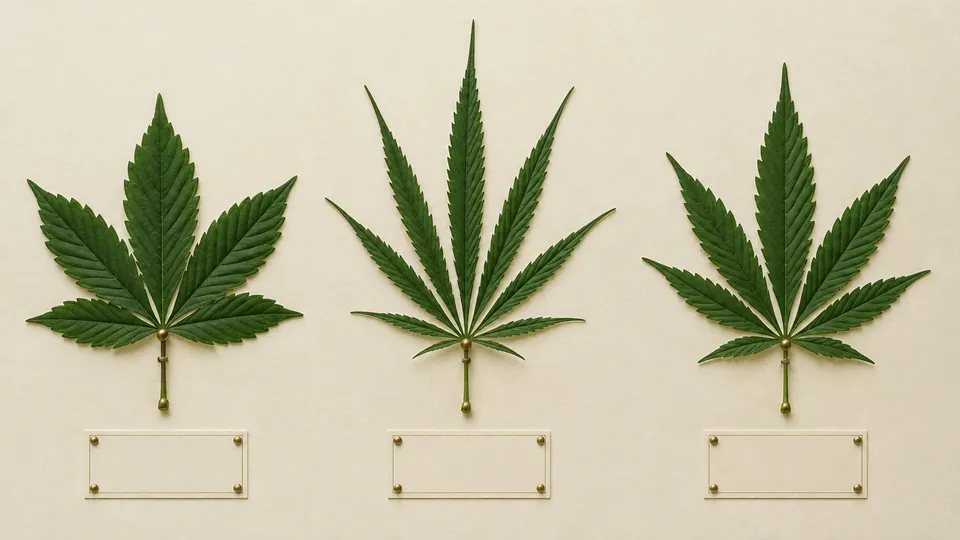
So what is a sativa, physically? Botanists describe tall, loosely branched plants with long, narrow leaflets. An indica, by contrast, is short and densely branched, roughly conical, with short, broad leaflets. Today many databases list cannabis as one species, Cannabis sativa, with subspecies sativa, indica and ruderalis, although some scholars still argue indica deserves species status, so the question is not fully settled.
Marijuana is the term many countries use for THC-type cannabis. A 2022 review in Plants explains that abroad, hemp and marijuana are conventionally separated at 0.3% THC by dry weight — a different threshold from Thailand's.
Why scientists say indica vs sativa labels are unreliable
In the market, "indica vs sativa" functions more as a product label than as botany. Researchers from Dalhousie University, Wageningen University & Research and Bedrocan analysed hundreds of cannabis samples and published the results in Nature Plants in 2021. Key findings:
- Indica/sativa labels were poor predictors of a sample's genetics and chemical composition.
- Trade names fared no better: samples sharing a name were often as different as samples with different names.
- There was only a weak link to a few aroma terpenes — "indica" samples leaned towards earthy-smelling terpenes, "sativa" samples towards fruity or tea-like ones.
The team called for an evidence-based naming system, especially for medical patients. A 2021 paper in Frontiers in Plant Science made a similar point: the labels are inadequate for medical use because they often rest only on leaflet shape, and generations of crossbreeding have eroded their reliability.
Caveat: an "indica", "sativa" or "hybrid" label on a product is not scientific confirmation of what the plant contains. Only laboratory results for THC and CBD content can tell you that, and any use of cannabis should be under a licensed practitioner as Thai law requires.
Chemotypes: the classification researchers actually use
Instead of leaf shape, researchers usually classify cannabis by chemotype — the ratio of the main cannabinoids (for the basics, see CBD vs THC explained). The common system looks like this:
| Chemotype | Defining feature | Thai strains classified this way |
|---|---|---|
| Type I (THC-dominant) | Clearly more THC than CBD | Hang Suea Sakon Nakhon TT1, Tanaosri Kan Khao WA1 |
| Type II (balanced) | THC and CBD roughly 1:1 | Hang Krarok Phu Phan ST1, Suranaree 3 |
| Type III (CBD-dominant) | Clearly more CBD than THC | Tanaosri Kan Daeng RD1 |
| Type IV / V | CBG-dominant / almost no cannabinoids | — |
Note: some documents swap the Type II and Type III numbers between the "balanced" and "CBD-dominant" groups, so always check the definitions used.
The Plants review notes that cannabinoid ratios are more stable than absolute amounts, which shift with environment and plant age. The Frontiers study sorted 82 plants into three chemotypes with 100% accuracy using secondary-metabolite profiles. That is why chemotype tells you more than an indica or sativa label.
How many Thai cannabis strains are there? Documented varieties
There is no single answer, because local landraces are spread across many regions and new varieties continue to be registered. Below are the strains we could verify from documents.
Four strains from the Department of Medical Sciences programme — In 2021 the Department of Medical Sciences, together with Rajamangala University of Technology Isan (Sakon Nakhon campus) and Mahidol University's Department of Botany, studied the botanical, chemical and genetic profiles of four Thai strains for medical use:
- Hang Krarok Phu Phan ST1 — Type II, THC:CBD about 1:1
- Hang Suea Sakon Nakhon TT1 — Type I, high THC
- Tanaosri Kan Khao WA1 — Type I, high THC
- Tanaosri Kan Daeng RD1 — Type III, high CBD
Thai PBS reported that in June 2021 the department's Herbal Research Institute handed these strains to RMUTI Sakon Nakhon and Kasetsart University's Sakon Nakhon campus to propagate as a seed source for farmers and product development, with plans to research root extracts.
Hang Krarok (often linked to "Thai stick") is also described in a review in the Journal of the Department of Medical Sciences as a Thai strain with an international reputation that tends to be high in THC.
Varieties registered with the Department of Agriculture under the Plant Variety Act of 1975 include:
- Suranaree 1 (Foi Thong Suranaree 1), Suranaree 2 and Suranaree 3 from Suranaree University of Technology, which received certificates on 21 April 2023. Suranaree 2 was selected from the "Foi Phu Phayon" population obtained from RMUTI Sakon Nakhon; Suranaree 3 has a THC:CBD ratio near 1:1.
- KD — According to the department's notice, the applicants were two individuals, and the variety comes from crossing a "Thong Nang" selection from a Koh Tao (Surat Thani) population with a plant of unknown variety, selected over 12 generations. Dried flower averaged 8.85% THC and 2.23% CBD (w/w). Prachachat reported KD's certification alongside Khiao Phangan 01, developed by community enterprise groups in Surat Thani, in March 2023.
Comparing documented Thai strains
| Strain | Developer / applicant | Published chemistry |
|---|---|---|
| Hang Krarok Phu Phan ST1 | DMSc, RMUTI Isan, Mahidol | Type II (THC:CBD ~1:1) |
| Hang Suea Sakon Nakhon TT1 | DMSc, RMUTI Isan, Mahidol | Type I (high THC) |
| Tanaosri Kan Khao WA1 | DMSc, RMUTI Isan, Mahidol | Type I (high THC) |
| Tanaosri Kan Daeng RD1 | DMSc, RMUTI Isan, Mahidol | Type III (high CBD) |
| Suranaree 2 | SUT | THC ~8–12%, CBD ~0.3–0.6% |
| Suranaree 3 | SUT | THC ~6–12%, CBD ~6–12% |
| KD | Two individual applicants (Koh Tao, Surat Thani) | THC avg 8.85%, CBD 2.23% |
These figures come from the developers' own documents under specific growing conditions; they are not guaranteed values for every plant.
Strain does not change legal status
Whether a plant is called indica, sativa or a Thai landrace, the law looks at the plant part and its chemistry, not the strain name.
- Flower of any Cannabis plant has been a controlled herb under a Ministry of Public Health notice since 26 June 2025. It may be dispensed only on a prescription from a listed practitioner, for no more than 30 days, and online sales and advertising are banned.
- Extracts of Cannabis plants are a Category 5 narcotic, except licensed extracts from domestically grown plants with no more than 0.2% THC by weight. For the bigger picture see Thailand cannabis law 2026.
- Hemp vs cannabis — Thai rules define hemp as having no more than 1.0% THC by dry weight in leaves and flowers, unlike the 0.3% threshold used abroad. Read more in Hemp in Thailand.
- The Cabinet approved a draft Cannabis Control Act on 22 September 2026, and the public health minister stressed that cannabis is currently for medical use only. The draft is not yet in force.
Growing any strain is subject to legal conditions — see Can you grow cannabis at home? and Cannabis benefits and risks.
Bottom line
The indica/sativa split has a real history in botany, but modern science finds chemotype — the THC:CBD ratio — far more informative. Thai strains such as Hang Krarok, Hang Suea and Tanaosri have been studied in medical research programmes, and new varieties continue to be registered. Whatever the strain, its legal status is the same.
FAQ
What is the difference between indica and sativa?
In classic botany, indica describes short, bushy plants with short, broad leaflets, while sativa describes tall plants with long, narrow leaflets. However, a 2021 study in Nature Plants found that the indica and sativa labels used in the market poorly reflect a plant's genetics and chemistry.
How many Thai cannabis strains are there?
There is no single official number, because many local landraces exist and new varieties keep being registered. Documented examples include the four strains developed with the Department of Medical Sciences (Hang Krarok Phu Phan ST1, Hang Suea Sakon Nakhon TT1, Tanaosri Kan Khao WA1, Tanaosri Kan Daeng RD1) and varieties registered with the Department of Agriculture such as Suranaree 1–3, KD and Khiao Phangan 01.
What is the KD cannabis strain?
KD is a cannabis variety registered with Thailand's Department of Agriculture. According to the department's notice, it comes from crossing a 'Thong Nang' selection from a Koh Tao (Surat Thani) population with a plant of unknown variety, selected over 12 generations. Dried flower tested at an average of about 8.85% THC and 2.23% CBD.
What is a cannabis chemotype?
A chemotype groups cannabis plants by their ratio of major cannabinoids, usually Type I (THC-dominant), Type II (THC and CBD roughly balanced) and Type III (CBD-dominant). Researchers note that these ratios are more stable than absolute amounts, which makes chemotype a more reliable description than indica or sativa labels.
Does the strain change cannabis's legal status in Thailand?
No. Since 26 June 2025, the flower of every Cannabis plant is a controlled herb, and extracts with more than 0.2% THC by weight remain a Category 5 narcotic, regardless of strain.
Sources
- Wikipedia — Cannabis sativa
- Wikipedia — Cannabis indica
- Simiyu, Jang & Lee (2022), Plants — Understanding Cannabis sativa L.: Current Status of Propagation, Use, Legalization...
- Jin, Henry, Shan & Chen (2021), Frontiers in Plant Science — Identification of Chemotypic Markers in Three Chemotype Categories of Cannabis
- Dalhousie University — Buyer beware: Study shows cannabis labelling can be misleading (Nature Plants, 2021)
- InfoQuest — Department of Medical Sciences, RMUTI and Mahidol develop four Thai cannabis strains for medical use
- Thai PBS — Anutin hands over Thai cannabis strains, root research for post-COVID lungs
- Department of Agriculture — Registered plant variety notice: Suranaree 2 and KD cannabis
- Prachachat — New cannabis varieties Khiao Phangan 01 and KD certified
- Naewna — Department of Agriculture registers three cannabis varieties for SUT
- Journal of the Department of Medical Sciences (2021) — Pharmacological and toxicological effects of cannabis
- Thai PBS — Royal Gazette publishes controlled-herb rule for cannabis flower, effective 26 Jun 2025
- Thai Post — Royal Gazette publishes MOPH Category 5 narcotics notice, 2022
- Hfocus — Cabinet approves draft Cannabis Control Act; minister says medical use only